
The book of Luke is the longest book in the New Testament and reads like a historical documentary. Theologians and historians who have written about the Gospel of Luke confirm that Luke was a physician, a scientist, a historian, and a Gentile.
The book of Luke is rich in theology, beginning with the account of the salvation that God promised long ago and accomplished through Jesus the Messiah, and what He continues to accomplish through His church.
Jesus makes the declaration of His mission clear:
The Son of Man came to seek and to save the lost (Luke 19:10).
Only Luke’s Gospel gives us the account of the presentation of the infant Jesus in the temple (2:21-38), and the praise of Simeon and Anna, Jesus’s visit to Jerusalem and the temple at the age of twelve (2:41-50), and of his obedience and subjection to Joseph and Mary in their home (2:51). Like a true physician, he records Jesus’ growth in stature, and like the true Christian historian, he records how Jesus, in his humanity, grew in wisdom and favor with God and men.
39 When Joseph and Mary had done everything required by the Law of the Lord, they returned to Galilee to their own town of Nazareth.
40 And the child grew and became strong; he was filled with wisdom, and the grace of God was on him.
41 Every year Jesus’ parents went to Jerusalem for the Festival of the Passover.
42 When he was twelve years old, they went up to the festival, according to the custom.
43 After the festival was over, while his parents were returning home, the boy Jesus stayed behind in Jerusalem, but they were unaware of it.
44 Thinking he was in their company, they traveled on for a day. Then they began looking for him among their relatives and friends.
45 When they did not find him, they went back to Jerusalem to look for him.
46 After three days they found him in the temple courts, sitting among the teachers, listening to them and asking them questions.
47 Everyone who heard him was amazed at his understanding and his answers.
48 When his parents saw him, they were astonished. His mother said to him, “Son, why have you treated us like this? Your father and I have been anxiously searching for you.”
49 “Why were you searching for me?” he asked. “Didn’t you know I had to be in my Father’s house?”
50 But they did not understand what he was saying to them.
51 Then he went down to Nazareth with them and was obedient to them. But his mother treasured all these things in her heart.
52 And Jesus grew in wisdom and stature, and in favor with God and man (Luke 2:39-52).
We know that Joseph and Mary lived a godly life, that Jesus was brought up in a God-fearing home. We know they followed the law, they circumcised Jesus on the 8th day, brought Him to the temple for the purification ceremony, and went up to Jerusalem for the Passover feast every year according to the law.
In verse 40, we see how He grew physically, mentally, and spiritually:

And the child grew and became strong; he was filled with wisdom, and the grace of God was upon him.
Through Luke’s report we can see He had a very normal childhood, growing and learning through his experiences.
Another vital part of a child’s life is spiritual growth. It is the responsibility of parents to bring their children up in the Lord so that they understand what it means to have a relationship with the One who created them.
In order to have the character and spiritual maturity they will need to face life - in the hope that they will seek God all their days and His calling on their lives, whatever that may be.
“It is the responsibility of the church to partner with parents in equipping their children with the Truth, so they have a firm foundation in Christ and mature as vital members of the body of Christ. ”
Like Jesus’ parents did, they taught Him biblical precepts in the home, brought him to the synagogue where He learned about God and His Word, and prepared Him to engage in the community.
In verse 42, we see that Jesus was then 12 years old. This was the first year Jesus could participate in the feast of Passover. We know before Jesus could celebrate the Passover he had to study the law and know the Torah.
How important is it to know the Word of God, to study the foundational teaching of the Scriptures so that we can enter into spiritual life of the church as well as impact society for good?
In verses 43-45 after the festival the caravan packed up and was heading home, Mary and Joseph thought Jesus was with the relatives and friends. Since by the end of the day’s journey they couldn’t find him, they backtracked to Jerusalem and looked for Him everywhere.
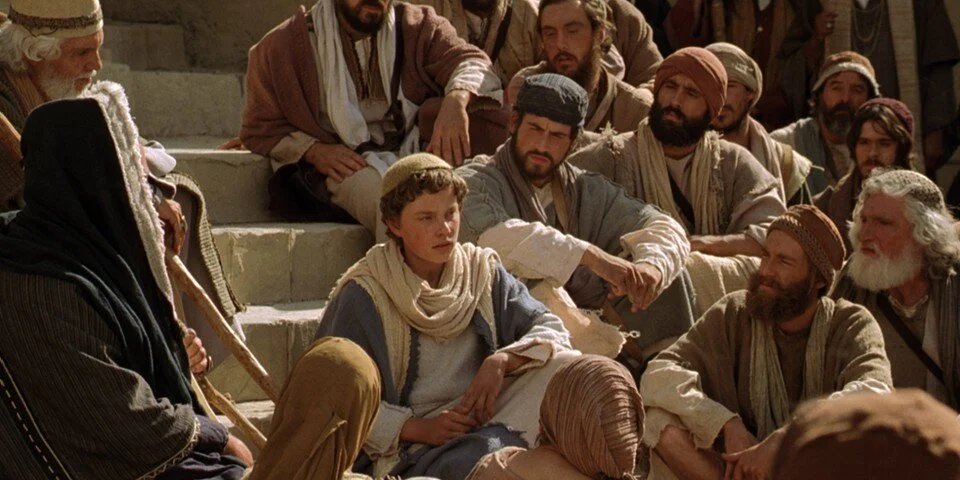
They found him sitting in the temple courts among the teachers, listening to them, learning and asking them questions.
In his humanity and in humility He was preparing for the mission God gave Him on earth. He not only asked questions, but also gave answers that revealed intelligence and an understanding that amazed everyone.
If the Creator of the Universe, in His humanity, went to the teachers of the law, shouldn’t we as God’s children also seek out more mature, wiser teachers, to learn under them, asking questions and giving answers?
Referring to verses 48 and 49, we find the first recorded words of Jesus:
“Didn’t you know I had to be in my Father’s house? ”
The Greek translation is “be about my Father's business.”
Jesus knew who He was, where He needed to be, and what God had called Him to do.
If Jesus is God, and God knows everything then why did He need to grow in wisdom, knowledge and favor with God?
Phil 2: 5 - 8 helps to clarify this question.
5 In your relationships with one another, have the same mindset as Christ Jesus:
6 Who, being in very nature God, did not consider equality with God something to be used to his own advantage;
7 rather, he made himself nothing by taking the very nature of a servant, being made in human likeness.
8 And being found in appearance as a man, he humbled himself by becoming obedient to death - even death on a cross!
As God the Son, He would not just do what He wanted but was totally submitted to His Father’s will and would not do anything that required His divine attributes or power unless the Father gave Him permission to do so. He had to be able to sympathize and understand our weaknesses and temptations, knowing exactly how it feels to be human in every respect as we are but without committing any sin (Hebr 4:15). Jesus was fully human, and His body had the same physical composition as yours and mine.
At the age of 12, Jesus already knew that He had to be about His Father’s business. These words convey a strong, divine calling.
“Everything He thought, said and did was to fulfill the perfect plan of His Father.”
Joseph and Mary didn’t understand what Jesus was talking about at the time, and though He understood His calling to His heavenly Father, we read something interesting regarding Jesus in His humanity...
51 He went down to Nazareth with them and was continually submissive and obedient to them; and His mother treasured all these things in her heart.
52 And Jesus kept increasing in wisdom and in stature, and in favor with God and men (Luke 2:51-52 AMP).
Luke then sums up the next 18 years of Jesus’ life in Nazareth:
At the age of 30 He would begin His mission and that required a devotion to God's purposes so great that it took precedence over the closest family ties. Even though it brought pain and misunderstanding, Jesus could not and would not be distracted from His purpose on this earth.

It was to seek and save lost people because that is what the Father sent Him to do, even though it meant death on the cross.
We have the daily, menial tasks we are responsible for as individuals, students, spouses, parents, employees, employers, but there is an overarching task to which God calls us.
Is there someone more spiritually mature and wiser than you, from whom you are learning, who can speak into your life, your challenges, where you can ask questions, get answers, and talk through things? Is there someone who takes us beyond the Bible study and challenges us to put godly principles and precepts into practice?
Whether we admit it or not, we are always learning something from someone, and we are, directly or indirectly always teaching others by our actions or inactions.
God calls us to be life-long learners!
That is the definition of a disciple. One who is a disciple is also called to make disciples of others and the next generation.
For those who are leading in any capacity - who are you following? Whose life or lives are you pouring into and impacting? As children of God, are we really convinced about who we are, why we are here and what God has called us to do?
When Jesus left this earth He said “I go to my Father and your Father.”
He is our Heavenly Father and we are here to do our Father’s business.